
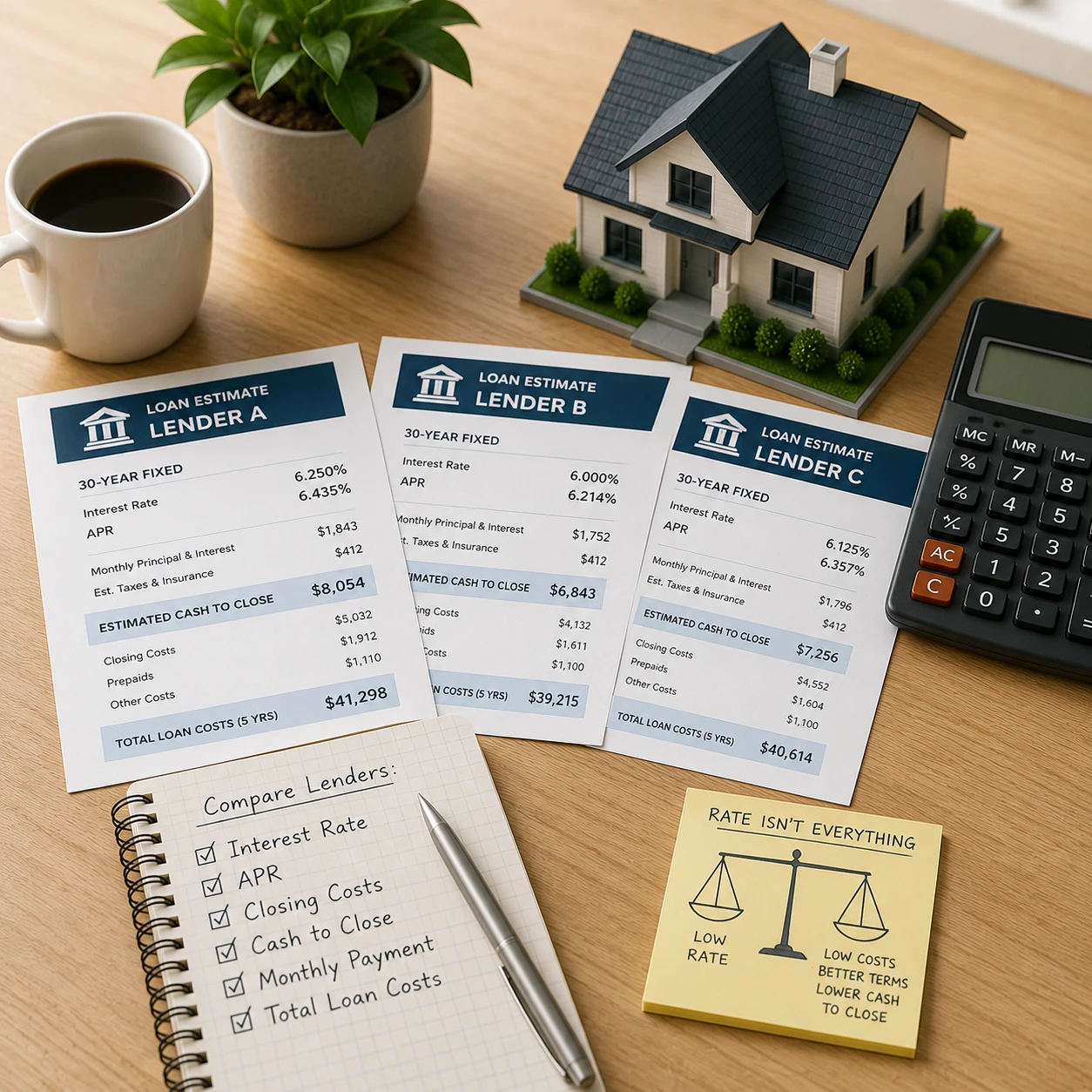


1. Request Loan Estimates from at least three lenders
Do not rely on one lender quote. After you submit a mortgage application, lenders are required to provide a standardized Loan Estimate within three business days. Use this document to compare lenders consistently. For a fair comparison, ask each lender to use the same purchase price, down payment, loan type, and estimated closing timeline. Different assumptions can make one offer look better than it really is.
2. Compare APR, Fees, and Cash-to-Close Together
Do not choose a mortgage based on the interest rate alone. A lower rate may come with higher points, lender fees, or upfront costs that change the real value of the offer. Compare the interest rate, APR, monthly payment, lender fees, prepaid costs, escrow items, and total cash-to-close together. The best loan is not always the one with the lowest advertised rate.
3. Understand Points and Lender Credits
Points and lender credits change how you pay for the loan. Points usually increase your upfront cost in exchange for a lower interest rate. Lender credits may reduce your cash-to-close but can increase your rate or long-term cost. Ask each lender for a no-points version of the same loan so you can see whether you are paying for a lower rate or simply comparing different cost structures.
4. Confirm Rate Lock Terms Before Committing
A quoted rate is not the same as a protected rate. Ask when the rate can be locked, how long the lock lasts, whether there is a fee, what happens if closing is delayed, and how much an extension would cost. This matters because a contract delay, underwriting issue, appraisal delay, or title problem can push closing past the lock period and increase your cost.
5. Compare Loan Types by Total Fit for Your Situation
FHA, conventional, VA, USDA, and state assistance programs can differ in down payment, mortgage insurance, funding fees, property standards, seller perception, and long-term cost. A loan with a lower upfront requirement may still be more expensive over time. Compare each loan type based on your cash position, credit profile, monthly payment, property type, offer strategy, and how long you expect to own the home.
6. Choose the Lender Who Offers the Best Total Value and Can Close on Time
The right lender is not only the cheapest lender. A lender must also communicate clearly, explain fees, meet contract deadlines, coordinate with your agent and title company, and close within the required timeline. A low-cost lender who cannot execute can put your earnest money, offer, and closing date at risk. Choose based on total cost, reliability, responsiveness, and proven ability to close purchase loans on time.
![[background image] image of topdown photo of desk with laptop (for a food and agtech)](https://cdn.prod.website-files.com/69fcbfd51b2bc69ac521880f/6a33dfa5776699afc5a2cd35_7182686e-6068-46b5-b231-80326bc2e7b3.avif)